
Sim racing is entering a defining era. Hardware precision, software intelligence, and immersive design are converging faster than ever. From direct-drive evolution to data-driven realism, the future of sim racing technology is not about spectacle alone, but about accuracy, accessibility, and long-term performance growth for serious drivers.
Sim racing has moved well beyond its niche origins. What was once a specialised hobby has matured into a sophisticated performance ecosystem, driven by advances in hardware engineering, simulation software, and digital connectivity. At the centre of this evolution is the pursuit of realism, consistency, and scalability. Entry points like Moza R5 show how professional-grade concepts are becoming accessible without sacrificing performance fundamentals.
The next phase of sim racing technology is not about isolated upgrades. It is about integrated systems that work together to replicate real-world driving behaviour with greater fidelity and efficiency.
Direct-Drive Technology Becomes the Standard
Precision over power escalation
Direct-drive wheelbases have reshaped expectations. Rather than chasing higher torque numbers alone, manufacturers are focusing on signal clarity, responsiveness, and thermal stability. Future systems prioritise smooth force delivery and low-latency feedback that reflects tyre load, surface detail, and vehicle balance with minimal filtering.
Key developments shaping this shift include:
- Improved motor control algorithms
- Higher-resolution encoders for steering accuracy
- More efficient cooling for sustained performance
As direct-drive becomes the baseline rather than the premium option, consistency and feedback quality will define value.
Pedals Evolve into Data-Driven Control Systems
Consistency as a performance metric
Pedal technology is evolving toward higher precision and deeper adjustability, reflecting its growing role as a core performance factor in sim racing. While load-cell braking is already widely established, future systems focus on dynamic calibration and detailed input analysis. Instead of measuring force in isolation, modern pedals are designed to track pressure curves, modulation patterns, and long-term repeatability. Features such as software-assisted brake tuning, adjustable resistance across throttle and clutch inputs, and consistency tracking help drivers refine technique over time. This shift reinforces a key performance truth: sustainable lap-time improvement comes from controlled, repeatable inputs rather than aggressive driving.
Software Intelligence Shapes Hardware Design
Simulation feedback loops
Modern sim racing software is increasingly shaping how hardware is designed and refined. As physics engines grow more advanced, they demand higher input resolution and faster feedback loops, pushing manufacturers to align firmware, electronics, and mechanical components more closely with simulation output. This tighter integration reduces latency between on-screen physics and physical feedback, improves the translation of tyre slip, weight transfer, and grip loss, and delivers more predictable vehicle behaviour under load. Mid-range ecosystems built around Moza R5 benefit significantly from this approach, as overall performance becomes driven less by raw hardware cost and more by intelligent system balance and responsiveness.
Modular Ecosystems Replace Isolated Components
Upgrade paths over replacement cycles
The future of sim racing technology favours modularity. Users increasingly expect ecosystems that allow gradual upgrades without full system replacement. Wheelbases, rims, pedals, and mounts are being designed as interconnected platforms rather than standalone purchases.
This approach delivers clear advantages:
- Lower long-term cost of ownership
- Easier adaptation to skill progression
- Greater hardware longevity
Modular design supports sustainable growth, enabling drivers to refine weak points without disrupting their entire setup.
Rig Stability and Ergonomics Gain Strategic Importance
Performance through physical consistency
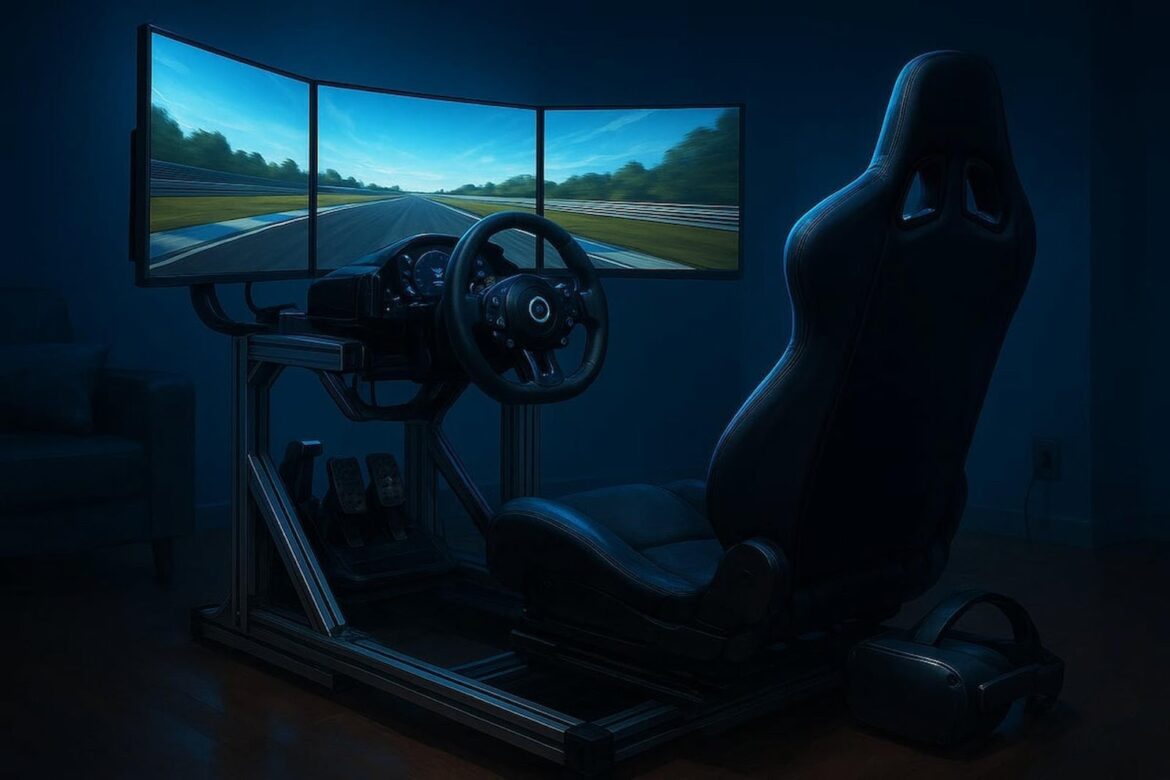
As input devices become more sensitive, mounting and ergonomics are no longer secondary considerations. Future rigs are engineered to eliminate flex, maintain alignment, and support long sessions without fatigue.
Key focus areas include:
- Chassis rigidity under braking load
- Adjustable seating geometry
- Precise pedal and wheel positioning
Technology alone cannot compensate for physical instability. The future places equal weight on structure and electronics.
Connectivity and Analytics Redefine Training
Insight replaces guesswork
Sim racing is increasingly shaped by connectivity and analytics, transforming how drivers approach improvement. Telemetry systems, cloud-based profiles, and performance tracking tools are becoming tightly integrated with hardware platforms, allowing drivers to move beyond intuition and access measurable trends in braking, steering, and throttle application. Features such as cross-session performance comparison, hardware-level input diagnostics, and profile-based configuration storage turn raw data into actionable insight. This analytical layer elevates sim racing from a trial-and-error activity into a structured, repeatable training environment focused on measurable progress.
Accessibility Without Diluting Performance
Broader entry, higher standards
One of the most significant trends is the narrowing gap between entry-level and enthusiast hardware. The future does not eliminate high-end equipment, but it raises the baseline. Products like Moza R5 reflect a shift where realistic force feedback, reliable pedals, and ecosystem compatibility are no longer exclusive.
This accessibility strengthens the entire sim racing landscape by:
- Encouraging skill development earlier
- Standardising control expectations
- Reducing reliance on arcade-style assists
Performance becomes a function of discipline and setup quality, not price alone.
What the Next Five Years Will Prioritise
Over the next five years, sim racing technology is expected to advance through refinement rather than dramatic reinvention. The focus will shift toward strengthening core fundamentals that directly influence performance, with improvements centred on reliability, system integration, and feedback accuracy instead of superficial features. Higher signal fidelity across all inputs, deeper hardware-software alignment, smarter calibration and tuning tools, and more durable, upgrade-friendly designs will define this period of development. The direction is clear: sustainable, long-term performance will take priority over novelty or short-lived innovation.
In Summary
The future of sim racing technology is defined by balance. Hardware precision, intelligent software, and physical stability are converging into unified ecosystems built for long-term performance. As direct-drive steering, advanced pedals, and modular platforms become standard, drivers benefit from greater realism and consistency without unnecessary complexity. Systems centred around solutions like Moza R5 demonstrate where the industry is heading—toward accessible, performance-focused technology that rewards control, discipline, and structured improvement rather than raw spending.